 Flappic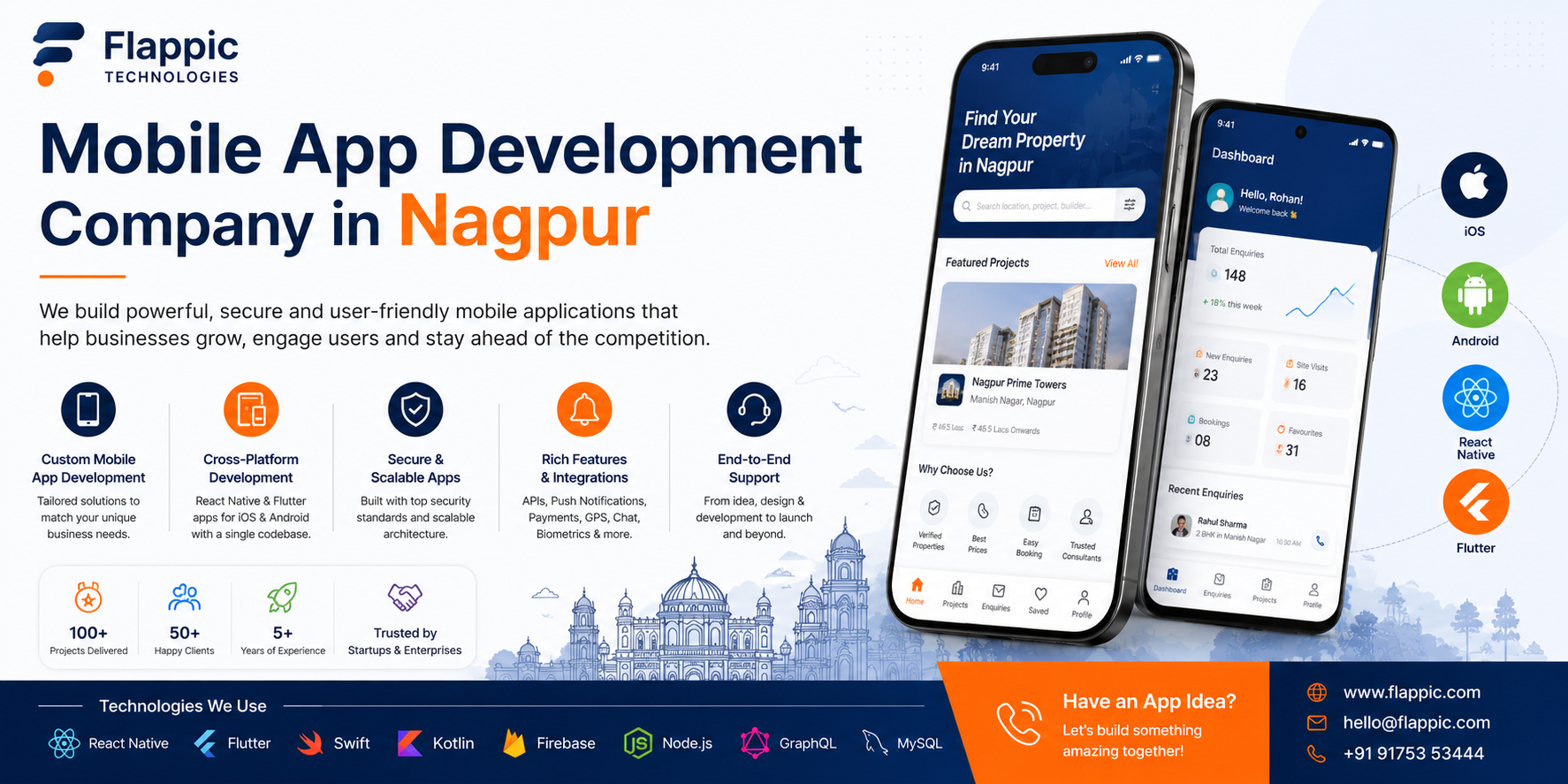
Mobile App Development Company in Nagpur: Complete Guide to Building a Successful Mobile App
Mobile applications have become an important part of how businesses interact with customers, manage operations, sell products, deliver services, and build digital products.
If you are searching for a mobile app development company in Nagpur, choosing a development partner should involve more than comparing prices. The right team needs to understand your business requirements, target users, app functionality, technology requirements, security needs, and long-term growth plans.
A successful mobile application should be easy to use, responsive, secure, scalable, and designed around a clear business objective.
Flappic Technologies develops mobile applications for iOS and Android using modern cross-platform and native technologies, with capabilities including React Native, Flutter, iOS Swift, Android Kotlin, Firebase, GraphQL, biometric authentication, push notifications, offline synchronization, and in-app payments.
What Is Mobile App Development?
Mobile app development is the process of designing, building, testing, deploying, and maintaining applications for mobile devices such as smartphones and tablets.
Depending on the project, mobile app development can involve:
- UI/UX design
- iOS app development
- Android app development
- Cross-platform app development
- Backend development
- API integration
- Database integration
- Authentication
- Push notifications
- Payment integration
- Location and map services
- Offline data synchronization
- Analytics
- App testing
- App Store and Play Store deployment
- Post-launch maintenance
The exact development approach depends on the type of application, target audience, required functionality, budget, performance expectations, and future product roadmap.
Why Businesses Need Mobile Applications
A mobile application can give businesses a direct digital channel to their customers. However, developing an app only makes sense when it solves a real customer or business problem.
Depending on the use case, a mobile application can help businesses:
- Improve customer engagement
- Provide faster access to services
- Increase repeat usage
- Enable online payments
- Offer personalized experiences
- Automate business processes
- Provide real-time notifications
- Collect customer information
- Manage bookings and appointments
- Build digital products and platforms
- Extend an existing website or software system
The important point is that an app should have a clear purpose. A business does not necessarily need a mobile application simply because competitors have one.
Types of Mobile Apps We Develop
Business Mobile Applications
Business applications can help companies provide services, communicate with customers, manage operations, or create dedicated digital experiences.
Examples include customer apps, service applications, employee applications, booking apps, and business management applications.
eCommerce Mobile Apps
An eCommerce mobile application can allow customers to browse products, search categories, add products to a cart, complete payments, track orders, and manage their accounts.
Depending on the business requirements, an eCommerce app can also integrate with inventory systems, payment gateways, CRM platforms, logistics systems, and existing websites.
Real Estate Mobile Apps
Real estate businesses can use mobile applications to help customers discover properties, view project details, submit enquiries, connect with consultants, and interact with property platforms.
Flappic's portfolio includes the Nagpur Prime Property Mobile App, a mobile-first real estate application built to help users discover properties, explore project details, connect with property consultants, and submit enquiries from smartphones.
View the Flappic Technologies Portfolio →
On-Demand Apps
On-demand applications can connect customers with businesses, professionals, delivery services, home services, transportation providers, or other service providers.
Such applications may require real-time status updates, location tracking, notifications, payments, user accounts, service provider dashboards, and administrative systems.
Booking and Appointment Apps
Businesses such as clinics, salons, consultants, fitness centers, educational institutions, and service providers can use mobile applications for appointments and bookings.
Features can include availability calendars, booking management, reminders, customer profiles, payments, and notifications.
SaaS and Product-Based Mobile Apps
If you are building a SaaS product, a mobile application can provide customers with access to important features from their smartphones.
For businesses developing a broader software product, explore Flappic's SaaS Development Services.
iOS vs Android App Development
One of the first decisions when building a mobile application is choosing which platforms to support.
iOS App Development
iOS applications are designed for Apple's ecosystem and can be developed using technologies such as Swift and Apple's development tools.
iOS apps need to be tested across supported Apple devices and prepared for submission through Apple's App Store review process.
Android App Development
Android applications target a broader range of devices and manufacturers. Android development can involve Kotlin and the Android development ecosystem.
Developers also need to consider differences in screen sizes, hardware configurations, Android versions, permissions, and device capabilities.
Cross-Platform App Development
Cross-platform development allows teams to build applications for multiple platforms using a shared codebase.
Flappic uses React Native and Flutter for cross-platform mobile development. Its mobile development service also lists iOS Swift and Android Kotlin among its technologies.
According to Flappic's current service page, its cross-platform approach is designed to provide substantial code reuse across iOS and Android while reducing overall development effort.
The correct choice should still be based on the application requirements rather than assuming cross-platform development is always better.
React Native vs Flutter: Which Is Better?
There is no universal winner between React Native and Flutter. The appropriate framework depends on the project's requirements, existing technology ecosystem, team expertise, integrations, performance needs, and long-term maintenance strategy.
React Native
React Native allows developers to build mobile applications using JavaScript and React-based development practices while targeting multiple platforms.
It can be useful for businesses that already have React-based web development experience or need a cross-platform mobile application.
Flutter
Flutter is Google's cross-platform UI toolkit that allows developers to build applications for multiple platforms using a shared development approach.
Flutter can be useful when a project requires highly customized interfaces and consistent visual experiences across platforms.
Which Technology Should You Choose?
Instead of choosing a framework because it is popular, evaluate:
- Required app features
- Platform requirements
- Existing technology stack
- Third-party SDK compatibility
- Performance requirements
- Development timeline
- Maintenance requirements
- Future scalability
A professional mobile app development company in Nagpur should explain these trade-offs before development begins.
Key Features of a Modern Mobile Application
1. User Registration and Login
Applications may support email login, mobile OTP authentication, social login, or biometric authentication depending on the use case.
2. Biometric Authentication
Mobile applications can use device-level biometric capabilities such as fingerprint or Face ID to provide convenient authentication where appropriate.
3. Push Notifications
Push notifications can be used for order updates, appointment reminders, promotions, account activity, new messages, and other time-sensitive information.
4. Offline Data Synchronization
Some applications need to continue working when internet connectivity is limited or unavailable.
Offline synchronization and local caching can allow selected data or functionality to remain available and synchronize with the backend when connectivity returns.
5. In-App Payments
Applications can integrate payment systems for purchases, subscriptions, bookings, services, or other transactions.
6. API Integration
Mobile applications often communicate with backend systems through APIs.
APIs can connect the application to databases, authentication systems, payment platforms, CRM systems, maps, analytics platforms, and other services.
7. Location and Maps
Location functionality can be useful for delivery apps, transportation platforms, real estate applications, service businesses, travel products, and location-based services.
When integrating location or map services, security and API-key restrictions should be implemented properly. Google recommends application restrictions and other security controls for Google Maps Platform integrations. Google Maps Platform security guidance.
Mobile App Development Process
Step 1: Requirement Discovery
The development process starts by understanding the business problem, target audience, app functionality, platform requirements, integrations, and expected outcomes.
Step 2: Product Planning
The next step is defining the minimum viable product, core features, user flows, technical architecture, and development roadmap.
For startups, this step is especially important because attempting to build every possible feature in version one can unnecessarily increase cost and development time.
Step 3: UX Research and Wireframing
The user experience is mapped before the complete interface is designed.
Wireframes help define navigation, screen hierarchy, user flows, and important interactions.
Flappic's mobile development process includes UX research and wireframing before the cross-platform build.
Step 4: UI/UX Design
The interface is designed around usability, brand identity, accessibility, navigation, and the target user's expectations.
Businesses that need dedicated product design can also explore Flappic's UI/UX Design Services.
Step 5: Mobile App Development
Once the design and technical architecture are approved, developers build the application and integrate required APIs, databases, authentication systems, notifications, payments, and other features.
Step 6: Backend and API Integration
Many mobile applications require a backend system to manage users, data, transactions, permissions, notifications, and business logic.
The mobile app is connected to the backend through secure APIs and appropriate authentication mechanisms.
Step 7: Testing and Quality Assurance
Testing should cover functionality, user flows, different screen sizes, operating systems, network conditions, permissions, performance, and security.
Flappic's mobile service includes QA and app-store release preparation, including beta testing through TestFlight and Play Console submission.
Step 8: App Store and Play Store Deployment
Publishing an application requires preparing store listings, application metadata, screenshots, privacy information, builds, signing, and platform-specific requirements.
The application should also comply with the relevant Apple App Store and Google Play policies.
Step 9: Post-Launch Maintenance
Mobile operating systems, devices, third-party APIs, SDKs, and platform policies change over time.
Ongoing maintenance can include bug fixes, performance improvements, compatibility updates, security improvements, feature enhancements, and platform updates.
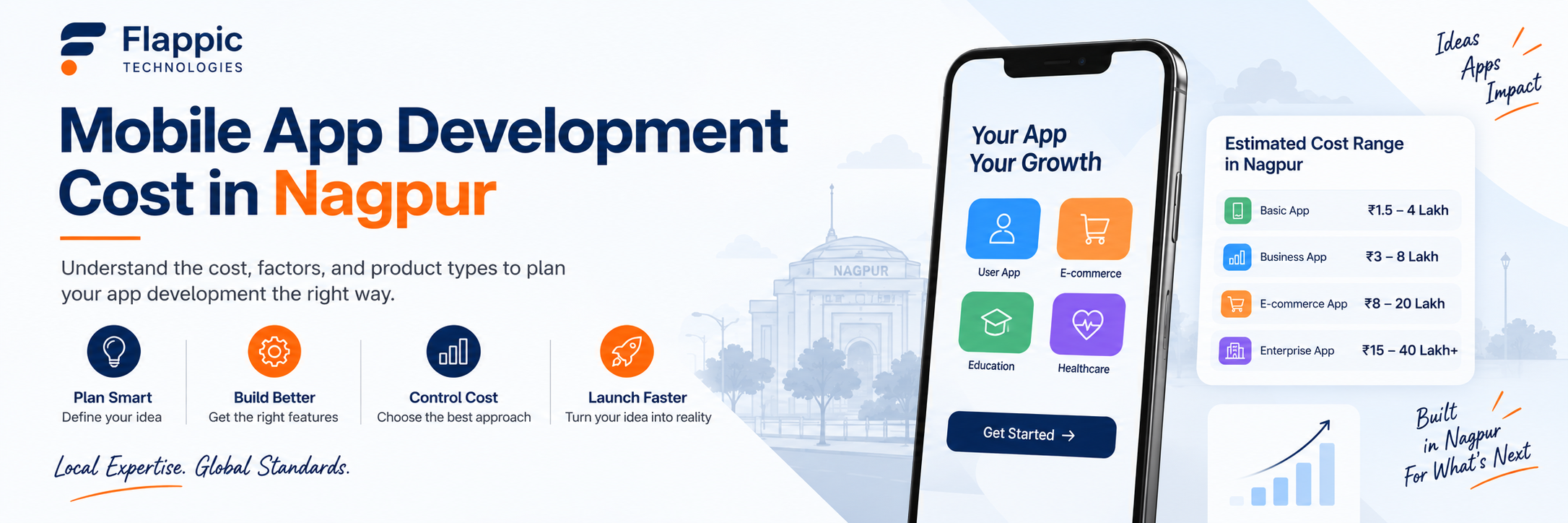
How Much Does Mobile App Development Cost in Nagpur?
There is no single fixed price for mobile app development in Nagpur. The cost depends on the complexity of the application and the amount of work required.
Important cost factors include:
- Number of platforms
- Number of screens
- UI/UX complexity
- User authentication
- Backend development
- Database requirements
- API integrations
- Payment gateway integration
- Push notifications
- Location and maps
- Real-time communication
- Offline functionality
- Admin dashboard
- Third-party services
- Security requirements
- Testing requirements
- App Store and Play Store deployment
- Post-launch maintenance
A basic business application and a large multi-user platform should not be compared using the same pricing model.
The most reliable way to estimate the cost is to define the required features, user flows, platforms, integrations, and backend requirements before requesting a quotation.
How Long Does It Take to Build a Mobile App?
The development timeline depends on the application's scope.
A relatively simple application with a limited number of screens and straightforward functionality can be developed faster than an application involving real-time communication, payments, complex backend systems, multiple user roles, offline synchronization, or advanced integrations.
The major factors affecting development time include:
- Number of features
- Design complexity
- Number of platforms
- Backend complexity
- API integrations
- Third-party services
- Testing requirements
- Client feedback and approvals
- App Store and Play Store review processes
Why Choose Flappic as a Mobile App Development Company in Nagpur?
Flappic Technologies develops mobile applications for iOS and Android using cross-platform and platform-specific technologies.
Its current mobile development offering includes:
- React Native
- Flutter
- iOS Swift
- Android Kotlin
- Firebase
- GraphQL
- Biometric authentication
- Push notifications
- Offline synchronization
- In-app payments and subscriptions
- App Store and Play Store release support
The broader Flappic service offering also includes web development, software development, SaaS, AI/ML, UI/UX, cloud architecture, cybersecurity, and engineering teams. This can be useful when a mobile application needs to connect with a broader digital product ecosystem.
Explore All Flappic Technologies Services →
Mobile App Development for Startups
Startups often make the mistake of trying to build the complete product before validating whether users actually need it.
A better approach can be to identify the core problem, define the essential features, build an MVP, collect user feedback, and then expand the product based on actual usage.
An MVP may include only the features required to validate the main business proposition.
For example, a marketplace app may initially need:
- User registration
- Product or service discovery
- Search
- Basic profiles
- Enquiry or purchase functionality
- Notifications
Advanced analytics, automation, loyalty programs, complex recommendation engines, or additional integrations can be introduced later when there is a clear business reason for them.
Mobile App Development for Small and Local Businesses
Not every local business needs a mobile app.
For some businesses, a well-designed website and strong digital marketing may provide better returns than building an app.
A mobile application becomes more relevant when customers have a reason to return frequently, need personalized accounts, make repeated bookings or purchases, require notifications, or need functionality that is better suited to a mobile device.
Businesses considering an app should therefore evaluate the expected customer behavior before investing in development.
Mobile App Security Considerations
Security should be considered from the beginning of app development rather than added as a final step.
Important areas include:
- Secure authentication
- Appropriate permissions
- Secure API communication
- Data protection
- Secure local storage
- API key protection
- Input validation
- Session management
- Secure payment implementation
- Dependency management
- Regular security updates
Google's current developer guidance emphasizes using only the permissions required by an application and following responsible privacy and security practices. Google Play Protect developer guidance.
Mobile App Performance Matters
A mobile application can have excellent functionality and still provide a poor user experience if it is slow, unstable, or consumes excessive device resources.
Performance considerations can include:
- Optimized images and media
- Efficient API requests
- Local caching
- Offline support where required
- Efficient database queries
- Reduced unnecessary network requests
- Memory management
- Efficient animations
- App startup performance
- Crash monitoring
Testing should be performed under realistic network and device conditions rather than only on a developer's high-performance device.
Mobile App Development and Backend Systems
A mobile application is often only one part of a larger technology system.
For example, an application may communicate with:
- Backend APIs
- Databases
- Admin dashboards
- CRM systems
- Payment gateways
- Notification services
- Analytics platforms
- Cloud infrastructure
- Third-party APIs
This is why businesses building complex applications should evaluate the development team's ability to handle the entire technology ecosystem rather than focusing only on the mobile interface.
For custom backend and business software requirements, explore Flappic's Software Development Services.
Mobile App Portfolio: Nagpur Prime Property
One example in Flappic's portfolio is the Nagpur Prime Property Mobile App.
The application was designed as a mobile-first real estate product that allows users to discover properties, explore project details, connect with property consultants, and submit enquiries directly from smartphones.
The project uses React Native, JavaScript, and React Navigation.
This type of application demonstrates how a mobile product can be connected to a real business workflow instead of functioning simply as a digital brochure.
View Flappic's Mobile App Portfolio →
Common Mistakes to Avoid When Developing a Mobile App
1. Building Too Many Features in Version One
Adding every possible feature can increase cost, development time, and complexity.
Start with the functionality required to solve the core user problem.
2. Ignoring User Experience
An application can technically work while still being difficult to use.
Navigation, screen hierarchy, forms, buttons, loading states, error messages, and onboarding should be considered carefully.
3. Developing Without a Backend Strategy
If the application requires user accounts, transactions, content management, or synchronized data, the backend architecture needs to be planned alongside the mobile application.
4. Ignoring Security
Sensitive information, authentication credentials, API keys, payment information, and user data require appropriate protection.
5. Testing Only on One Device
Android and iOS users may have different screen sizes, operating system versions, hardware capabilities, and network conditions.
Testing across representative devices and environments is therefore important.
6. Forgetting Post-Launch Maintenance
An application is not a one-time development project.
Operating systems, SDKs, APIs, libraries, devices, and store requirements change over time. Maintenance should be included in the long-term product plan.
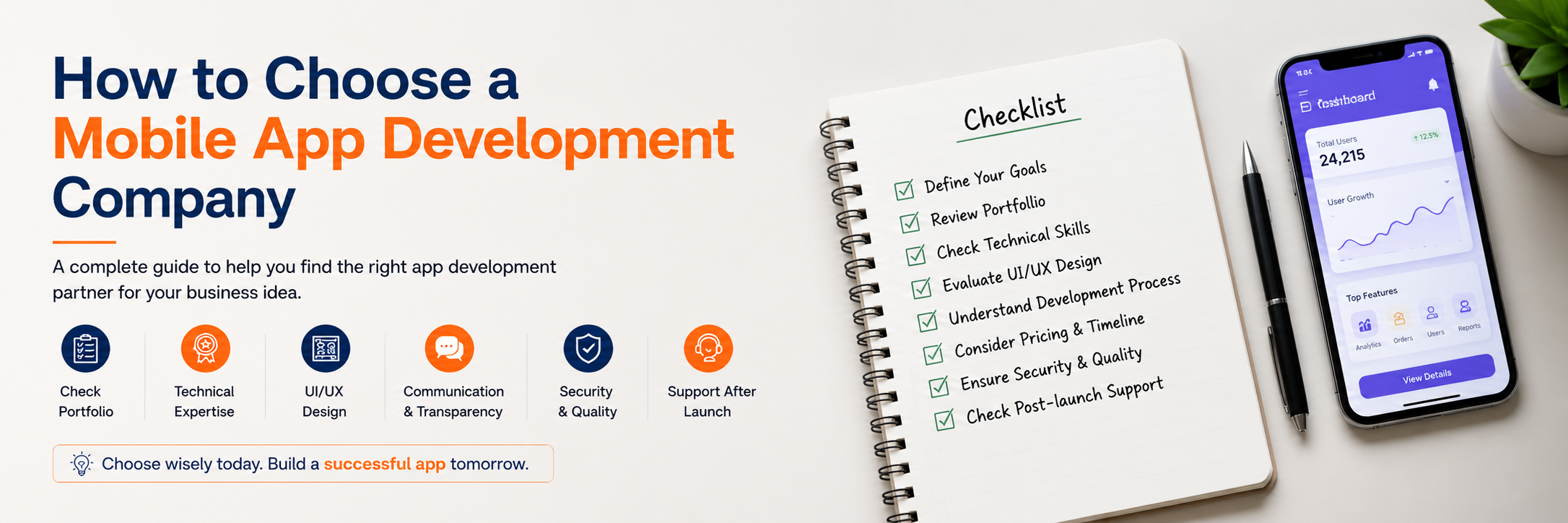
How to Choose the Right Mobile App Development Company in Nagpur
Before hiring a mobile app development company in Nagpur, ask the following questions:
- Have you developed applications similar to my business idea?
- Which technologies do you recommend and why?
- Should my app be native or cross-platform?
- Will you handle UI/UX design?
- Will you develop the backend and APIs?
- How will authentication and security be implemented?
- How will the application be tested?
- Will you handle App Store and Play Store submission?
- Who owns the source code?
- What post-launch support is included?
- How will future features be added?
- How will the app communicate with my existing website or software?
Frequently Asked Questions About Mobile App Development in Nagpur
Which is the best mobile app development company in Nagpur?
There is no single mobile app development company that is the best choice for every business. The right partner depends on your requirements, technology needs, budget, portfolio, development process, communication, ownership terms, and post-launch support.
How much does mobile app development cost in Nagpur?
The cost depends on the app's features, number of platforms, UI/UX complexity, backend requirements, integrations, authentication, payments, notifications, testing, and maintenance.
A detailed feature and technical requirement document is the best starting point for an accurate estimate.
How long does it take to build a mobile application?
The timeline depends on the complexity of the application. A simple MVP can be developed faster than a large application involving multiple user roles, payments, real-time functionality, complex backend systems, and third-party integrations.
Should I build an Android or iOS app first?
The answer depends on your target customers, market, business model, budget, and product strategy. If your customers use both platforms, cross-platform development may be worth considering.
Is React Native good for mobile app development?
React Native can be a practical choice for many cross-platform applications. However, the right technology depends on the project's requirements, integrations, performance expectations, existing technology ecosystem, and long-term maintenance needs.
Is Flutter good for mobile app development?
Flutter can be suitable for applications that require cross-platform development and highly customized interfaces. The framework should still be evaluated against the specific requirements of the project.
Can Flappic develop both Android and iOS applications?
Yes. Flappic's mobile app development service covers iOS and Android applications using technologies including React Native, Flutter, Swift, and Kotlin.
Can Flappic develop the backend for a mobile app?
Yes. Mobile applications that require backend systems, APIs, databases, authentication, dashboards, or business logic can be developed as part of a broader software solution.
Can Flappic help publish an app on the Play Store and App Store?
Flappic's mobile development service includes QA and app-store release preparation, including TestFlight and Play Console submission support.
Mobile App Development and Other Digital Services
A mobile application may eventually need to connect with a website, SaaS platform, custom software, AI system, or cloud infrastructure.
Flappic provides multiple technology services that can be combined when a project requires a broader digital product ecosystem.
Final Thoughts
Choosing a mobile app development company in Nagpur should not be based only on the lowest quotation or the number of technologies listed on a company's website.
The more important factors are whether the development partner understands your product, can design a practical user experience, can build the required backend and integrations, understands mobile security and performance, and can support the application after launch.
A successful mobile application is not simply an app that gets published to the App Store or Play Store. It should solve a real problem, provide a useful experience, and have a technical foundation that can support future growth.
If you are planning a business application, startup MVP, eCommerce app, real estate application, SaaS mobile product, or custom mobile platform, Flappic Technologies can help you plan and develop the product from concept to production.
Ready to Build Your Mobile App?
If you are looking for a mobile app development company in Nagpur, discuss your business idea, target users, required features, preferred platforms, integrations, and expected outcomes before starting development.
Talk to Flappic Technologies About Your Mobile App Project →
Explore Flappic Technologies
- Mobile App Development Services
- Web Development Services
- Software Development Services
- UI/UX Design Services
- SaaS Development Services
- AI & Machine Learning Services
- All Flappic Services
- Flappic Technologies Portfolio
- Contact Flappic Technologies
Author: Flappic Technologies
Location: Nagpur, Maharashtra, India
Primary Keyword: Mobile App Development Company in Nagpur
Secondary Keywords: Mobile App Development Services in Nagpur, Mobile App Development Company Nagpur, Android App Development Company in Nagpur, iOS App Development Company in Nagpur, React Native App Development Company in Nagpur, Flutter App Development Company in Nagpur, App Developers in Nagpur, Custom Mobile App Development in Nagpur