 Flappic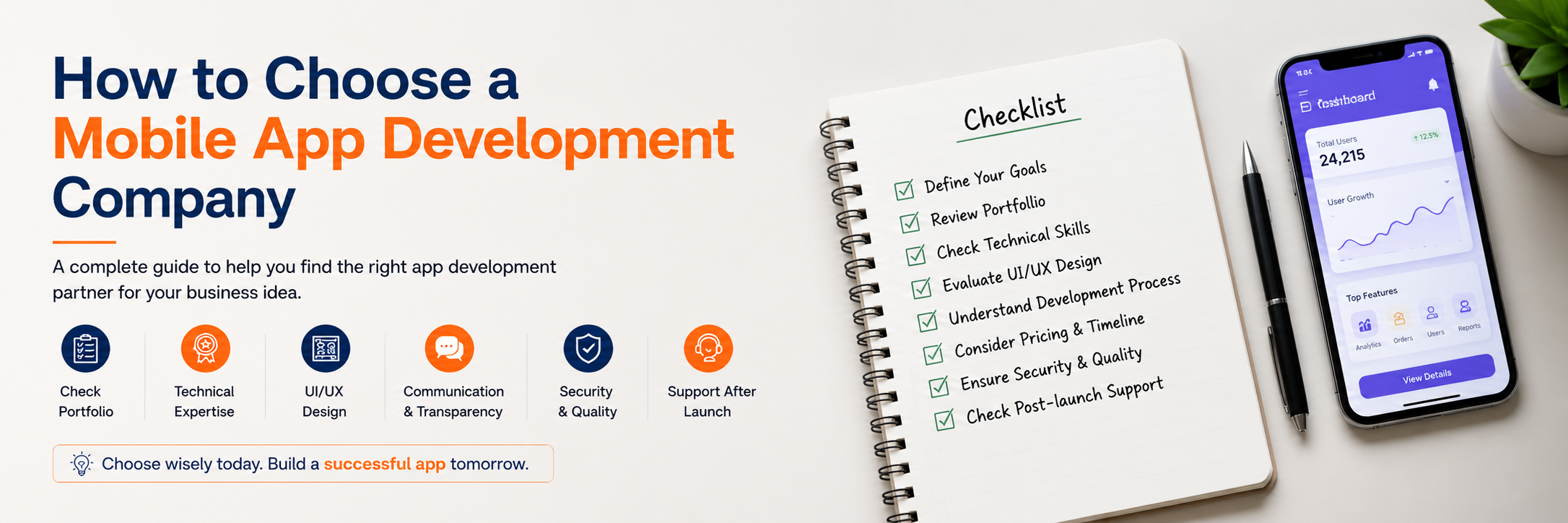
How to Choose a Mobile App Development Company
Choosing the right mobile app development company can have a major impact on the success, cost, performance, and long-term scalability of your mobile application. Whether you are building a startup app, business application, customer-facing platform, marketplace, or enterprise mobile solution, the development partner you choose can determine how effectively your idea is converted into a reliable product.
However, choosing an app development company should not be based only on the lowest quotation or the number of technologies listed on a company's website. You should evaluate its experience, portfolio, development process, UI/UX capabilities, technical expertise, communication, security practices, post-launch support, and understanding of your business requirements.
If you are currently comparing app development companies, this guide explains how to choose a mobile app development company, what questions to ask before hiring one, what red flags to avoid, and how to evaluate proposals.
If you are looking for a development partner, you can also explore Flappic's Mobile App Development Services.
Why Choosing the Right Mobile App Development Company Matters
A mobile application is not simply a collection of screens. A production-ready application may require UI/UX design, frontend development, backend APIs, databases, authentication, notifications, payment integrations, analytics, security, testing, deployment, and ongoing maintenance.
The Development Partner Affects the Entire Product
The company you hire can influence technical architecture, user experience, development speed, application stability, scalability, and future maintenance costs. A poor development decision at the beginning can become expensive to correct after the application has already been launched.
Problems Caused by Choosing the Wrong Company
- Unclear project requirements
- Unexpected development costs
- Frequent delays
- Poor application performance
- Weak UI/UX
- Security vulnerabilities
- Unmaintainable code
- Limited scalability
- Poor communication
- Lack of post-launch support
Define Your Mobile App Requirements Before Hiring a Company
Before contacting a mobile app development company, define what you actually want to build. You do not need a complete technical specification, but you should understand the business problem, target users, major features, and expected outcome.
Identify the Purpose of Your App
Start by answering one simple question: What problem will the mobile application solve? The answer will help the development company understand the product and recommend the appropriate technology and development approach.
Common Mobile App Types
- Business applications
- Customer service apps
- E-commerce applications
- Marketplace apps
- Real estate applications
- Healthcare applications
- Education apps
- Finance applications
- Entertainment applications
- Social networking apps
- On-demand service apps
- Enterprise applications
Prepare a Basic Feature List
Create a list of the features you believe the application requires. This can include registration, login, profiles, search, payments, messaging, notifications, booking, dashboards, maps, subscriptions, or any other functionality.
A clear feature list makes it easier to compare proposals from different development companies because each company can estimate approximately the same scope.
Check the Company's Mobile App Development Portfolio
One of the most important steps when choosing a mobile app development company is reviewing its previous work. A portfolio can provide more useful information than a list of technologies.
Look for Relevant Projects
Do not only look at how attractive an application's screenshots appear. Look for projects that demonstrate experience with similar functionality, industries, user volumes, integrations, or technical complexity.
What to Check in a Portfolio
- Types of mobile applications developed
- Android development experience
- iOS development experience
- UI/UX quality
- Backend integration
- Complex features
- Third-party integrations
- Business domain experience
- Published applications
- Long-term product development
You can review Flappic Technologies' Portfolio to see examples of digital products and applications developed for different business requirements.
Evaluate the Company's Technical Expertise
A mobile application can be developed using different technologies. The right choice depends on the product requirements, performance expectations, development budget, target platforms, and long-term roadmap.
Native vs Cross-Platform App Development
One important question is whether your application should be developed natively for iOS and Android or using a cross-platform framework.
Native development can provide platform-specific capabilities and performance, while cross-platform development can allow a shared codebase across multiple platforms. Neither approach is automatically better for every project.
Questions to Ask the Development Company
- Which technology do you recommend for this application?
- Why is that technology appropriate?
- Will the application support both Android and iOS?
- How will the backend be developed?
- How will APIs be structured?
- What database technology will be used?
- How will the application scale if users increase?
- How will security be handled?
Check Backend and API Development Capabilities
A mobile app is usually only one part of a larger system. Most production applications require backend services, databases, APIs, authentication, admin panels, notifications, analytics, and integrations.
If your project also requires a web application or backend platform, you can explore Flappic's Web Development Services.
Evaluate UI/UX Design Capabilities
A technically functional application can still fail if users find it confusing or difficult to use. UI/UX should therefore be evaluated separately from programming capability.
Look Beyond Attractive Screenshots
Good mobile app design is not simply about colors, animations, and visual effects. The design should make navigation understandable and allow users to complete important tasks with minimal friction.
Important UI/UX Areas
- User flows
- Navigation
- Information architecture
- Wireframes
- Mobile responsiveness
- Accessibility
- Forms and validation
- Error handling
- Onboarding
- Design consistency
For dedicated product design requirements, explore Flappic's UI/UX Design Services.
Ask About the Mobile App Development Process
A professional development process should be structured rather than simply starting development immediately after receiving a feature list.
Requirement Analysis
The first stage should involve understanding the business requirements, target users, application features, user roles, integrations, technical requirements, and expected outcomes.
UI/UX Design
The next stage generally involves user flows, wireframes, interface design, prototypes, and design approval before development begins.
Development
Developers then build the mobile application, backend services, APIs, databases, authentication, integrations, and other required components.
Testing
The application should be tested across relevant devices, operating systems, screen sizes, network conditions, and user scenarios before release.
Deployment
Once the application has passed testing and received approval, it can be prepared for deployment to the relevant app stores and production infrastructure.
Maintenance
After launch, the application may require bug fixes, operating system compatibility updates, security improvements, performance optimization, and new features.
Ask for a Clear Mobile App Development Proposal
Before hiring a mobile app development company, ask for a written proposal that clearly explains what is included in the project.
What Should a Proposal Include?
- Project scope
- Feature list
- Platforms
- Technology stack
- UI/UX scope
- Backend development
- Third-party integrations
- Testing
- Deployment
- Estimated timeline
- Payment milestones
- Maintenance terms
- Source code ownership
Do Not Compare Only the Final Price
Two companies can quote very different prices for what appears to be the same application. The difference may come from design quality, development architecture, testing, security, documentation, support, or the actual features included in the proposal.
Compare the scope and deliverables, not just the total quotation.
Understand Mobile App Development Costs
There is no fixed cost for developing a mobile application. The final cost depends on the complexity of the product and the amount of development required.
Factors That Affect App Development Cost
- Number of screens
- Number of features
- Android and iOS requirements
- Native or cross-platform development
- Backend complexity
- Admin panel
- Payment integrations
- Maps and location services
- Real-time communication
- AI features
- Third-party APIs
- Security requirements
- Testing requirements
- Cloud infrastructure
A simple business application and a large marketplace application can have completely different development requirements. Therefore, requesting a generic "app development price" without defining the scope usually produces an unreliable estimate.
Check Communication and Project Management
Communication problems can cause as many problems as technical issues. Before hiring a company, understand how communication will happen throughout the project.
Important Communication Questions
- Who will be the primary project contact?
- How frequently will progress updates be provided?
- How will requirements be documented?
- How will changes be handled?
- How will bugs be reported?
- How will approvals be managed?
- Will the client receive development builds?
Regular Development Builds Matter
Receiving regular builds or demonstrations allows you to review progress instead of discovering major differences only at the end of the project.
Check App Security Practices
Security should be considered from the beginning, particularly for applications that handle personal information, payments, business data, or sensitive customer information.
Important Mobile App Security Areas
- Secure authentication
- Authorization
- API security
- Data encryption
- Secure storage
- Input validation
- Session management
- Access control
- Secure payment processing
- Database security
Ask the development company how security will be incorporated into the application's architecture rather than treating security as an activity performed only before launch.
Check App Store and Play Store Experience
If your application will be distributed through Google Play or Apple's App Store, the development team should understand the technical and submission requirements of the relevant platforms.
App Store Deployment
The development team may need to help with application configuration, production builds, signing, store assets, testing, privacy requirements, and submission-related technical work.
Google Play Deployment
Android applications also require appropriate release configuration, signing, testing, store assets, and compliance with Google Play requirements.
Ask the development company whether deployment support is included in the project quotation or charged separately.
Consider Scalability Before Development Begins
An application that works for 100 users may require a different architecture when it reaches 100,000 users. Scalability should therefore be considered according to your expected growth.
Scalability Areas to Discuss
- Backend architecture
- Database performance
- API architecture
- Cloud infrastructure
- File storage
- Caching
- Load management
- Monitoring
- Backup strategy
You should not necessarily pay for enterprise-scale infrastructure from day one. The better approach is to create an architecture that can evolve as the product grows.
Consider Whether Your App Needs SaaS Features
If you are building an application that will be sold to multiple customers, you may require SaaS functionality such as subscriptions, tenant management, billing, user permissions, analytics, and scalable infrastructure.
For software products intended to operate as SaaS platforms, explore Flappic's SaaS Development Services.
Common SaaS Mobile App Features
- User accounts
- Subscription plans
- Recurring billing
- Multiple organizations
- Role-based permissions
- Usage tracking
- Notifications
- Analytics
- Admin management
Consider AI Integration for Your Mobile Application
AI can be useful in mobile applications when it solves a specific business or user problem. Examples include intelligent search, recommendation engines, conversational interfaces, document processing, image analysis, personalization, and predictive features.
However, adding AI simply because it is popular can increase complexity without creating meaningful value. The use case should be defined before selecting an AI technology.
If your application requires AI capabilities, explore Flappic's AI & Machine Learning Services.
Red Flags When Choosing a Mobile App Development Company
Some warning signs should make you reconsider a development partner before signing a contract.
Unusually Low Quotation
A very low price is not automatically a good deal. It may indicate that important components such as testing, backend development, UI/UX, deployment, or maintenance have not been included.
No Clear Scope
If the company cannot clearly explain what will be delivered, how will it estimate the project timeline and cost accurately?
No Relevant Portfolio
A company does not necessarily need experience in your exact industry, but it should be able to demonstrate technical capability relevant to your application's complexity.
No Post-Launch Support
Mobile operating systems, devices, APIs, and third-party services change over time. Completely abandoning the application after launch can create long-term problems.
Promises Without Technical Explanation
Be cautious if a company promises extremely short delivery times or unusually advanced functionality without explaining the technical approach, scope, limitations, or dependencies.
Questions to Ask Before Hiring a Mobile App Development Company
Before signing an agreement, ask questions that help you understand how the company will actually handle your project.
Technical Questions
- Which technology will you use and why?
- Will the app be native or cross-platform?
- How will the backend be developed?
- How will APIs be secured?
- How will the application scale?
- How will testing be performed?
Business Questions
- What is included in the quotation?
- What is excluded?
- What is the estimated timeline?
- How are changes handled?
- Who owns the source code?
- Who owns the app store accounts?
- What support is provided after launch?
How Flappic Approaches Mobile App Development
Flappic Technologies provides mobile application development as part of its broader digital product development services. The approach can include product planning, UI/UX design, mobile application development, backend development, integrations, testing, deployment, and ongoing improvements depending on project requirements.
You can learn more about Flappic's Mobile App Development Services before discussing your application requirements.
From Idea to Mobile Product
A mobile application project can begin with a simple concept and evolve into a complete digital ecosystem involving mobile applications, web platforms, backend systems, dashboards, APIs, and cloud infrastructure.
Flappic also provides custom software development services for projects that require a larger software platform behind the mobile application.
Additional Services
- Mobile App Development
- Software Development
- Web Development
- UI/UX Design
- SaaS Development
- AI & Machine Learning
Frequently Asked Questions About Choosing a Mobile App Development Company
How do I choose a mobile app development company?
Start by defining your requirements and then compare companies based on relevant portfolio experience, technical expertise, UI/UX capabilities, development process, communication, security, pricing, ownership terms, and post-launch support.
How much does it cost to hire a mobile app development company?
The cost depends on the application's features, platforms, backend requirements, integrations, design complexity, testing, and development approach. A proper estimate requires a defined project scope.
Should I choose a company based on the lowest price?
No. The cheapest proposal may not include important components such as testing, UI/UX, backend development, deployment, security, or maintenance. Compare the complete scope and deliverables instead.
Should I build a native or cross-platform mobile app?
It depends on the project. Native development can be appropriate when platform-specific performance or functionality is critical, while cross-platform development can be useful when you want to share a significant portion of the codebase between platforms.
How long does mobile app development take?
There is no universal timeline. A basic application may require considerably less development time than a marketplace, fintech application, social platform, or enterprise application with complex backend functionality and integrations.
Should I develop an MVP first?
For many startups, an MVP can be a practical approach because it allows the core product idea to be tested before investing in a large feature set. However, the MVP should still have a stable technical foundation and usable experience.
What should I check in an app development company's portfolio?
Look for relevant application types, design quality, technical complexity, integrations, platform experience, and evidence that the company has worked on real products rather than only creating demo applications.
Does Flappic provide mobile app development services?
Yes. Flappic Technologies provides mobile application development services for businesses, startups, and digital product requirements. You can review the mobile app service offering at Flappic's Mobile App Development Services.
Conclusion: Choosing the Right Mobile App Development Company
Choosing a mobile app development company should be treated as a business and technology decision, not simply a price comparison. The right development partner should understand your requirements, recommend an appropriate technology approach, create a usable product, follow a structured development process, test the application properly, and provide support after launch.
Before making your final decision, compare portfolios, technical expertise, development processes, communication methods, security practices, project scope, pricing, ownership terms, and maintenance options.
If you have a mobile app idea and want to discuss the technical requirements, you can contact Flappic Technologies to discuss your project.
Explore Flappic Technologies
- Mobile App Development Services
- Software Development Services
- Web Development Services
- UI/UX Design Services
- SaaS Development Services
- AI & Machine Learning Services
- All Flappic Services
- Flappic Technologies Portfolio
- Contact Flappic Technologies
Author: Flappic Technologies
Location: Nagpur, Maharashtra, India
Primary Keyword: How to Choose a Mobile App Development Company
Secondary Keywords: Mobile App Development Company, How to Choose an App Development Company, Best Mobile App Development Company, Mobile App Developers, App Development Company, Hire Mobile App Developers, Mobile Application Development Company, Android and iOS App Development Company, Custom Mobile App Development Company